
Hee Lun Chinese Temple Priest — Tingha
By the mid-1860s Quin Jack was working on the Uralla – Rocky River goldfields in Northern NSW. He arrived in Tingha in the early 1870s. By the 1880s he was already a significant figure in the Chinese community. He had strong business ties, was well connected with the Chinese Masons or Yee Hing Society, and was intimately associated with the Chinese temple.
This Priest is believed to be Hee Lun who officiated at the Chinese Temple in Tingha from 1879-1909. Anecdotally he was also known as half-brother, adopted brother or blood-brother of Quin Jack. In ‘Tin at Tingha’ by Helen Brown, (no relation) Quin is credited with building the main Chinese temple or Joss House.
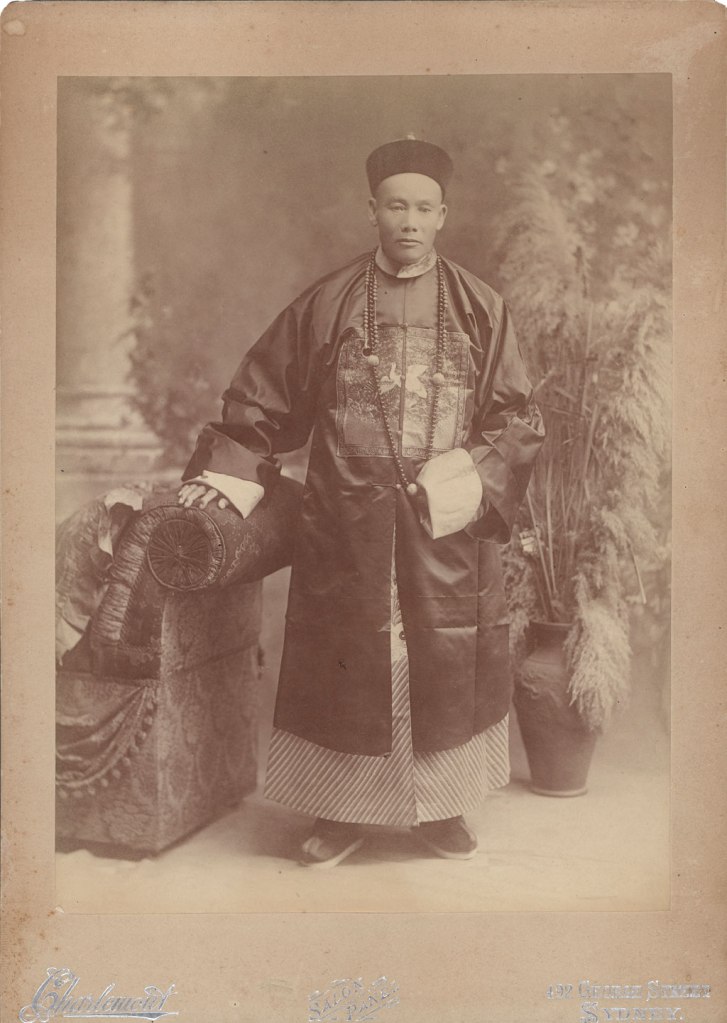
He is dressed in imperial robes of a Qing dynasty official, of the 6th Civil Rank (with egret). According to Brad Powel “… Mechanical embroidery was starting to appear as the government (or certain functionaries/consuls) turned more of the robes out as a means of fund-raising from the Chinese diaspora“.
According to Paul Macgregor “ … the robe Hee Lun is wearing in your photo, is a robe of official rank. One would have to have been awarded (or bought) such rank from the Chinese imperial government, otherwise you were not allowed to wear it. There was a tour of 2 representatives of the Chinese government to Australia in 1887. They were called the “Chinese commissioners” and a number of well-off Chinese Australians were awarded/purchased rank from these representatives. From the following articles it looked like it perhaps was planned for them to visit Tingha, but they may not have got there in the end. They may have got to Glen Innes, Inverell or Tenterfield … I am surprised that a priest would have afforded to purchase rank. So perhaps Hee Lun was more than just a priest.
http://nla.gov.au/nla.news-article13662013
Newspaper articles at the time of the opening claim – “The New Joss-house is by far the best yet, constructed in the locality, and its interior fittings and decorations are well executed, and evidence that a considerable amount of taste had been brought into play” … “the temple was said to have cost over 2,000 pounds1.
A Chinese Festival at Tingha 1886
Hee Leen (Lun) is mentioned as the principle priest over seeing this spectacular rare historical Chinese festival at Tingha in November 1886. “… The building covered a space of about 100,000 square feet. The building, exhibits, &c., cost about £2,000, and were visited during Friday, Saturday, Sunday, and Monday last by nearly 20,000 people of all classes and ages. …. The King of Heaven sat on a throne, richly decorated with gold leaf,. …” Read the full article.2
According to Ely Finch it is a 羅天大醮 or jiao festival — a religious ceremony to prevent calamities and misfortunes and to comfort departed souls.
http://nla.gov.au/nla.news-article164382729

Image credit: https://www.master-insight.com/香港最大型的醮會/
1) OPENING OF A CHINESE JOSS HOUSE. (1883, February 27). Illawarra Mercury (Wollongong, NSW : 1856 – 1950), p. 4. Retrieved March 17, 2024, from http://nla.gov.au/nla.news-article136460221
2) Chinese Festival at Tingha. (1886, December 11). The Sydney Mail and New South Wales Advertiser (NSW : 1871 – 1912), p. 1238. Retrieved March 17, 2024, from http://nla.gov.au/nla.news-article164382729
 Chen Quin Jack
Leave a comment