This Chinese opium tin dates from between 1860 – 1900, with it in the collection is a tiny tobacco or opium pipe, may have been owned by Chen Quin Jack or William Tootong, another Chinese ancestor. Both men were gold and tin miners around the Uralla and Tingha regions during the 1860s to 1910s. Opium was used medicinally, as recounted by my grandfather Trevor Jack in this excerpt from a transcript from an interview by Janis Wilton at Coonabarabran on 25 June 1990. Excerpt courtesy of Janis Wilton.
Trevor is referring to his father, Fred Jack, about family history and being able to speak Chinese
” …no father never. He didn’t talk about it at all and yet he could speak Chinese and never taught us Chinese. But he could speak it and he used to act as interpreter in the early days of Inverell because a lot of the Chinese up there, and there were quite a few of them around used to smoke opium, in those days. Which is frowned upon now, naturally. But in those days it was something they had been used to all their lives. Just have a pipe at night. They’d have ‘sweet dreams’, sort of thing and of course the police would come down and raid them occasionally. He used to go up and interpret what they were saying and probably Harry Fay would have bailed them out, see. And of course a lot of gambling went on up there, too, in those days. Nothing much else to do.“
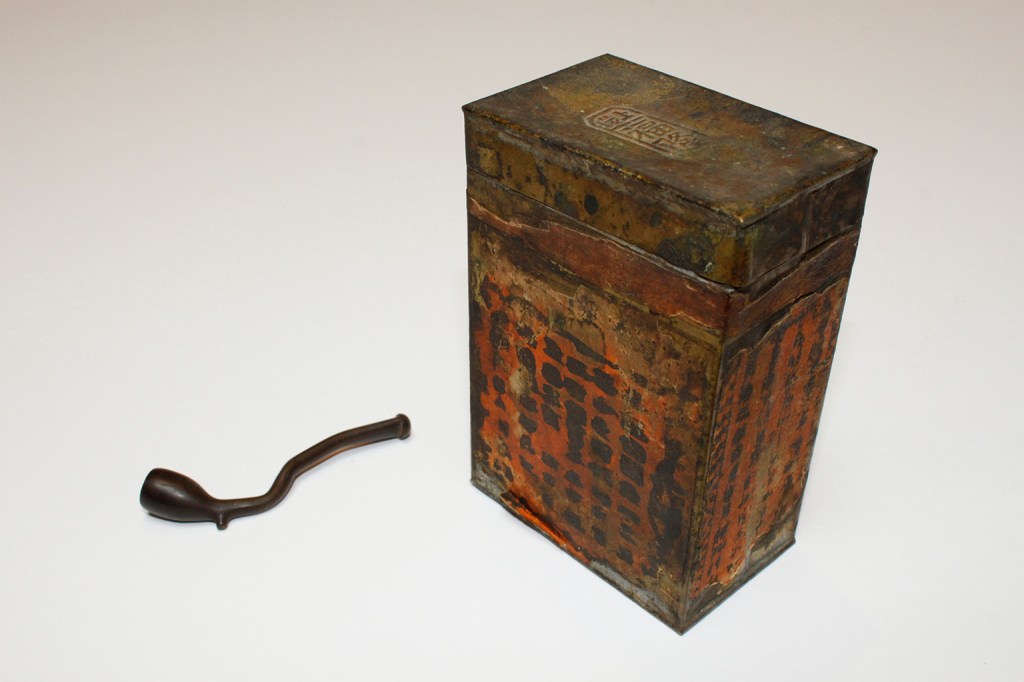


The opium tin (100mm h x 90mm w x 60mm d) is made of copper metal with an embossed Chinese marking on the lid and is wrapped in an orange paper label printed with Chinese characters, the text of which could be a brand name, manufacturer, or possibly a consumer greeting. these tins were used to store and import opium, each tin held around 186.5grams of the black sticky gum like substance.
The significance of objects like opium tins, as explained by Janis Wilton1, lies in their role within a larger collection of items essential for understanding the history of Chinese communities on the goldfields. These tins are important because they relate to key themes of the Gold Rush experience, including racial antagonism and the fear of the exotic and unknown. Additionally, they highlight Australia’s connections to Britain and the development of racial discrimination policies following Federation.
For more information, see 1860 Gold Fields Chinese Opium Box, from Object Through Time
- Wilton, J 2004, Golden Threads: The Chinese in Regional New South Wales 1850 -1950. Powerhouse Museum Publishing.
↩︎
 Chen Quin Jack
Leave a comment